Do You Fear Eating Carbs? Learn How to Overcome It

Let’s talk about something that might hit close to home: the fear of carbs. Yep, those supposedly “bad” guys—bread, pasta, rice, even fruit sometimes.
Thanks to diet trends like keto and all the conflicting advice floating around online, carbs have gotten a seriously bad rap. Somewhere along the way, eating a slice of toast started feeling like breaking the rules.
If you’ve ever felt anxious about eating carbohydrates, you’re not alone. This fear of carbs—sometimes called “carb phobia”—is more common than you might think.
But here’s the truth: carbs aren’t the enemy. In fact, they’re essential to a healthy, balanced diet.
And yes, you can enjoy them without guilt.
In this article, we’re going to unpack where this fear comes from, bust some common carb myths, and most importantly, walk through how you can start to feel at peace with food again.
Ready? Let’s dive in!
Why Do So Many People Fear Eating Carbs?
Remember when fat was the food villain?
For years, we were told to steer clear of anything with oil, butter, or too much avocado (gasp!). That kicked off the low-fat craze and a widespread fear of dietary fat—something even got its own name: lipophobia.
But then the script flipped. Fat started making a comeback, and carbs?
Well, they became the new enemy.
Enter the low-carb movement—Atkins, Keto, LCHF. These diets didn’t just suggest cutting back on carbs; they practically told us to avoid them like the plague.
Bread? Nope. Pasta? Off-limits. Even fruit and certain veggies got caught in the crossfire.
Before we knew it, fear of carbs—also called carbophobia—became totally normalized.
It wasn’t just a diet choice anymore; it was a mindset.
SAVE THIS PIN FOR LATER!
Be sure to save this post by pinning the image to your Pinterest board. I’ll be updating it regularly, so you can easily come back to explore this topic further!

But let’s take a step back for a second.
Does cutting out an entire food group really sound like balance? Or are we just caught in another cycle of diet culture disguised as “wellness”?
The Role of Diet Culture and Misinformation
Here’s the truth: diet culture loves extremes. It sells us the idea that thinner is always better, that food needs to be labeled “good” or “bad,” and that the next miracle product is just one click away.
And unfortunately, carbs often end up in diet culture’s crosshairs.
Thanks to flashy marketing and influencer noise, carbs have been unfairly blamed for everything from weight gain to bloating to low energy.
We’re constantly told that cutting carbs is the “smart” choice—but rarely given the full picture.
The reality?
Carbohydrates are your body’s main source of fuel. When you eat carbs, your body breaks them down into glucose, which powers your brain, muscles, and pretty much every cell in your body.
So when you cut carbs too drastically, it’s no surprise if you feel tired, moody, foggy, or just… off. But instead of realizing your body is missing something essential, you might be tempted to blame the very thing it needs.
It’s not your fault—it’s the messaging. And it’s time we unlearn it.
Related Article: 11 Easy Steps on How to Start Eating Healthy»
The Truth About Water Weight
Let’s clear up a big source of confusion: water weight. When your body stores carbs as glycogen, it also holds onto water—it’s totally normal biology.
So yes, when you cut carbs, you might see the number on the scale drop fast. But here’s the catch: that’s not fat loss. It’s mostly water.
And when you start eating carbs again?
Your body naturally holds onto that water once more. That slight bump on the scale?
Still not fat. Still nothing to panic about.
Now, let’s talk about that out-of-control feeling. For a lot of people, finally eating carbs after a long period of restriction can feel like opening the floodgates.
You might go from “just one bite” to suddenly inhaling the whole bag of chips—and then feel guilty about it.
But here’s the truth: that’s not because carbs are addictive. It’s because restriction fuels obsession.
The more we tell ourselves we can’t have something, the more power it holds over us.
So what if we shifted the question? Instead of asking, “Should I eat carbs?”, what if we asked, “Which carbs help me feel good—energized, satisfied, and nourished?”
Because the goal isn’t to fear carbs. It’s to understand them—and to give ourselves permission to enjoy them again.
Related Article: 6 Tips on How to be Naturally Thin – Without the Struggle»
The Truth About Carbohydrates
Let’s get one thing straight: carbs are not the enemy. In fact, they’re one of the three essential macronutrients your body needs—right alongside fats and proteins.
Carbohydrates are made up of sugar molecules, and when you eat them, your body breaks them down into glucose (a type of sugar in your blood).
That glucose?
It becomes your body’s main fuel—powering everything from your brain to your workouts to just getting through your day.
Your body can either use that glucose right away or store it in your liver and muscles for later, kind of like charging a battery.
Carbs come in a few different forms, and they’re digested at different speeds depending on their structure.
Here’s a quick breakdown:
- Sugars (simple carbs): Found in candy, soda, and other sweet treats—but also in natural sources like fruit and dairy.
- Starches (complex carbs): These show up in foods like potatoes, rice, corn, and whole grains.
- Fiber (complex carbs): Found in fruits, vegetables, legumes, and whole grains. Fiber slows digestion, helps you feel full longer, and supports gut health.
Understanding the types of carbs helps you make smarter, more balanced food choices—not cut them out entirely.
Get the eBook
Join now to receive our FREE ebook on how to create a healthy relationship with food.

How Much Carbs Do We Actually Need?
Here’s a stat that might surprise you: according to the Dietary Guidelines for Americans, about 45–65% of your daily calories should come from carbohydrates.
If you’ve been told carbs are “bad,” that number might seem high—but for most people, it’s exactly what the body needs to thrive.
Now, this isn’t a strict rule. Everyone’s needs are different.
If you’re active, you might need even more carbs to fuel your workouts and recovery. If you live a more sedentary lifestyle or have certain health conditions, your needs might be lower—and that’s okay too.
The key takeaway?
You don’t need to fear carbs. Your body needs them—especially when they come from whole, fiber-rich sources like fruits, veggies, legumes, and whole grains.
It’s not about cutting carbs out. It’s about choosing the ones that help you feel energized, full, and well-nourished.
Quality and balance always win over extremes.
Related Article: How to Make Intuitive Eating Work For You and Support Weight Loss»
Understanding Simple Carbs
Let’s bust a big myth: not all simple carbs are bad for you. The term “simple carbohydrates” often gets thrown around like it’s a red flag—but that’s only part of the picture.
Fruits, vegetables, and dairy?
Yep, they’re technically simple carbs. But they also come packed with important nutrients like vitamins, minerals, antioxidants, and—especially in fruit—fiber.
That fiber is key. It slows down digestion, which means the natural sugars in things like fruit (such as fructose) don’t cause huge blood sugar spikes like you might expect.
Your body knows how to handle them—especially when they’re part of a whole, nutrient-dense food.
So no, you absolutely don’t need to avoid simple carbs across the board. It’s not about cutting them out—it’s about knowing which simple carbs serve your body best.
The Simple Carbs to Be Cautious Of
The real issue isn’t with simple carbs in general—it’s the refined and processed ones. These are the carbs that are loaded with added sugars and stripped of their nutrients, often referred to as “empty calories.”
They give you a quick burst of energy, but not much else.
These carbs digest quickly, causing your blood sugar to spike, and because they don’t keep you full for long, you’re often left reaching for more food sooner than expected.
Over time, eating too many of these can contribute to weight gain.
And here’s where the fear of carbs usually starts. It’s not carbs in general—it’s these ultra-processed, nutrient-poor carbs that set you up for energy crashes, cravings, and bloathing.
Here’s a quick list of the culprits:
- Processed sugary cereals
- Sodas
- Potato chips and corn chips
- French fries
- Candies
- Doughnuts
- Soft pretzels
- Canned fruits
These kinds of carbs are the ones you want to be cautious with.
Related Article: How to Identify Ultra-Processed Foods and Make Healthier Choices»
Understanding Complex Carbs
Most of the carbs found in plants are classified as complex carbohyrates—and they’re often considered the “good” kind.
Why?
Because they’re not only more nutrient-dense, but they’re also digested more slowly, which helps keep your energy levels steady and your hunger in check.
This slower digestion is especially helpful if you’re trying to manage your weight. When you feel fuller for longer, you’re less likely to reach for sugary or processed snacks between meals.
Even within the world of complex carbs, there’s a difference.
Unprocessed complex carbs—the ones found in whole foods—tend to be far more beneficial than their refined counterparts, which have been stripped of fiber and essential nutrients during processing.
Here are some examples of healthy complex carbs to include in your diet:
These foods are rich in fiber, vitamins, minerals, and antioxidants—making them excellent choices for your body and overall health.
SAVE THIS PIN FOR LATER!
Be sure to save this post by pinning the image to your Pinterest board. I’ll be updating it regularly, so you can easily come back to explore this topic further!

All or Nothing? Not Necessary
Here’s the thing: you don’t need to cut out all the less nutritious carbs forever to eat well or be healthy. There’s no prize for perfection.
In fact, allowing space for occasional treats is what makes a balanced lifestyle sustainable in the long run.
Personally, I’ve never put carbs—or any food group—on a forbidden list. I don’t live by strict rules or fear eating certain foods, and that’s exactly why I don’t feel deprived.
Because I don’t restrict, I don’t obsess.
And that freedom?
It makes it so much easier to stick to a mostly healthy, balanced way of eating—for life.
I truly believe that by embracing moderation instead of restriction, you can build a healthier, more peaceful relationship with food—one that supports both your physical and mental well-being.
Related Article: The Ultimate Guide to Sustainable Weight Loss: Eat Better, Not Less»
What Are Fibers and Why Do We Need Them?
Fiber is a type of carbohydrate, but here’s the twist: unlike other carbs, your body can’t fully digest or absorb it. Instead, it passes through your digestive system mostly intact.
But don’t be fooled—just because it doesn’t get broken down, doesn’t mean it’s not doing some serious work.
Fiber plays a huge role in your overall health. It helps keep your digestive system running smoothly, supports heart health, and even helps manage weight by making you feel full longer.
There are two main types of fiber, and both are important in their own way:
Soluble Fiber
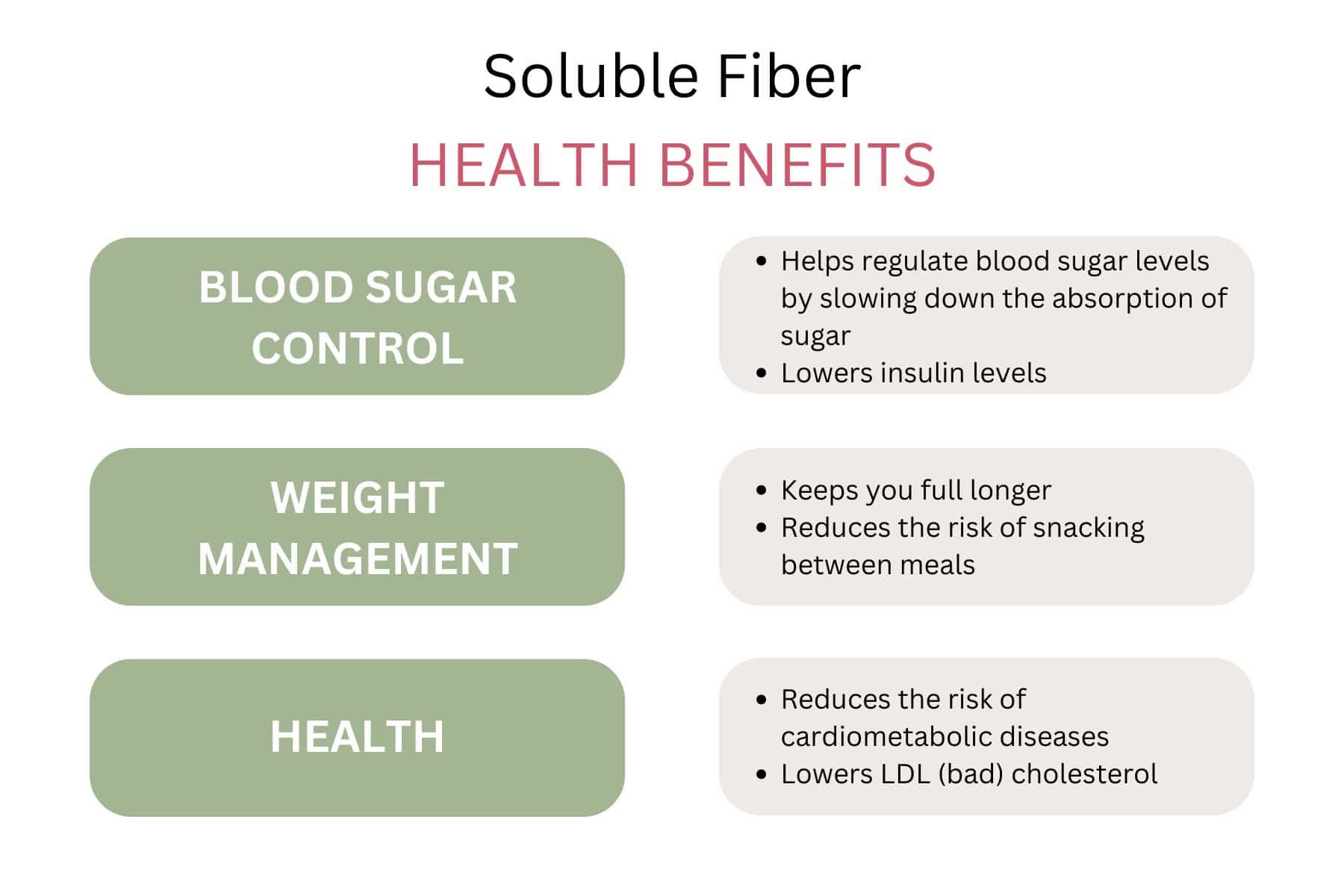
Soluble fiber is a special type of fiber that dissolves in water and forms a gel-like substance in your digestive tract.
Sounds a little weird, right?
But it’s actually really good for you.
Even though it’s technically a carbohydrate, your body doesn’t digest or absorb it like other carbs. Instead, it moves through your system while doing a lot of behind-the-scenes work to support your health.
One of the best things soluble fiber does is slow down the digestion of carbohydrates. This helps sugar enter your bloodstream more gradually—so you avoid those sharp blood sugar spikes (and the crashes that follow).
The result?
More stable energy and fewer cravings.
Soluble fiber also plays a key role in lowering cholesterol levels. It binds to cholesterol particles and helps carry them out of your body before they make their way into your bloodstream.
That’s a major win for heart health.
You’ll find soluble fiber in lots of plant-based foods, such as:
Insoluble Fiber
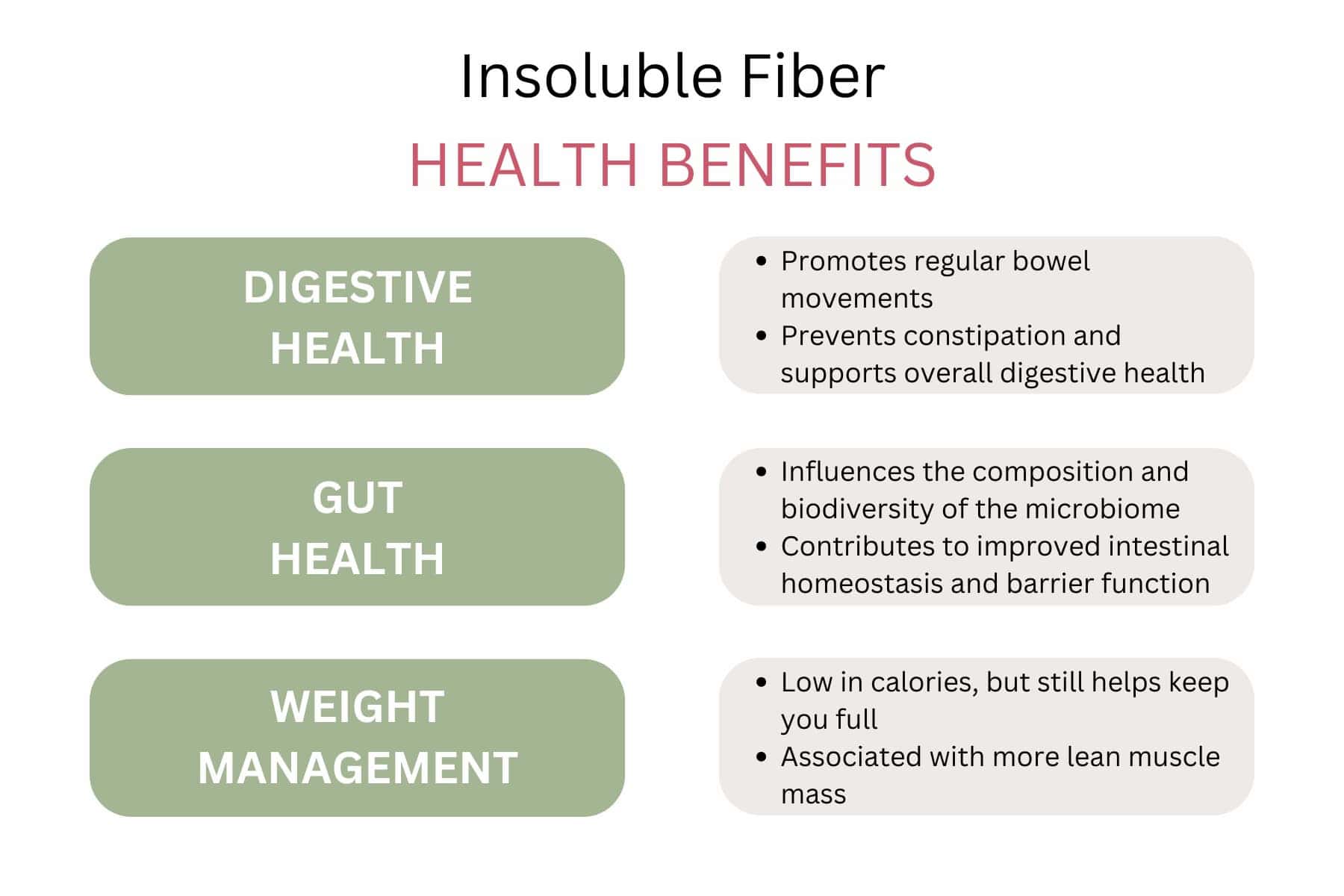
Unlike its soluble counterpart, insoluble fiber doesn’t dissolve in water—but it still plays a vital role in your gut health. It keeps its structure all the way through your digestive system, helping to add bulk to your stool and keep things moving smoothly.
In other words: it helps prevent constipation and supports regular bowel movements.
That’s not just about comfort—it’s also about protecting your digestive system, flushing out waste efficiently, and lowering the risk of issues like colon disease.
Even though your body doesn’t absorb or digest this type of fiber, that’s actually part of what makes it so valuable. By speeding up the movement of food through your gut, insoluble fiber helps sweep out toxins and keeps your colon in good shape.
Want to get more of this gut-friendly fiber in your diet?
Add these foods to your plate:
Healthy Tip: Remember to drink plenty of water when consuming fiber. Fiber draws in water, so staying hydrated helps prevent constipation and dehydration.
Get the eBook
Join now to receive our FREE ebook on how to create a healthy relationship with food.
Overcoming the Fear of Carbs
If you’ve been avoiding carbs out of fear, you’re not alone. For years, we’ve been bombarded with messages telling us that carbs are “bad,” that they’ll make us gain weight, or that we need to cut them out to be healthy.
But here’s the truth: you don’t have to fear carbs to be well or feel good in your body.
Carbs are a natural, essential part of a balanced diet, and the fear surrounding them has often been fueled by misinformation and extreme diet culture.
The reality is, carbs—especially the right kinds—can actually support your energy, help you feel satisfied, and nourish your body.
So, here are some steps you can take to overcome your fear of carbs:
Step 1: Reframe the Way You Think About Carbs
Start by challenging the old narrative. Carbs are not the villain—they’re fuel. They’re what your brain, muscles, and metabolism thrive on.
Choosing nutrient-dense carbs like whole grains, fruits, legumes, and vegetables is a smart way to nourish your body while still enjoying variety and flavor.
Ask yourself: Are you afraid of carbs because of what you’ve heard—or because of what your body is actually telling you?
When we restrict carbs too harshly, we often end up craving them more and feeling out of control around food. That’s not a sign of weakness—it’s a natural response to deprivation.
Related Article: 5 Tips on How to Create a Healthy Relationship with Food»
Step 2: Add, Don’t Subtract
Instead of focusing on cutting carbs out, focus on adding better carbs in. Think whole, fiber-rich foods that keep you satisfied and energized.
Try swapping ultra-processed options with more balanced ones: oats instead of sugary cereal, whole grain toast instead of white bread, or fruit instead of candy.
You don’t have to do it all at once—small changes lead to lasting habits, and every step toward more nourishing carbs counts.
Step 3: Tune In, Not Out
Rebuild trust with your body by actually listening to it. When you eat carbs, how do you feel? Are you more focused, energized, satisfied?
Often, our bodies give us the answers we’ve been trying to get from diet rules.
Let go of the all-or-nothing mindset. It’s okay to eat pasta on a weeknight or enjoy a piece of cake at a party. Food is not just fuel—it’s also comfort, culture, connection, and celebration.
Final Thoughts
Overcoming the fear of carbs isn’t about depriving yourself or cutting out entire food groups—it’s about shifting your mindset and understanding that carbs are an essential part of a balanced, healthy diet.
By reframing how you think about carbs and focusing on the nourishing, whole-food options available, you can fuel your body without guilt.
Remember, it’s not about perfection; it’s about creating lasting, sustainable habits that support both your physical and mental well-being.
Embracing carbs in their most nutrient-dense forms, like whole grains, fruits, and vegetables, can actually help you feel more energized, satisfied, and connected to your body. The key is balance, not restriction.
You deserve to feel good about food. You deserve to enjoy it. And yes—you deserve carbs.
*This article is for informational purposes only and is not intended as medical advice. It should not be used to diagnose, treat, or prevent any health condition. Always consult a qualified healthcare professional before making any changes to your diet, exercise, or health routine.
Bodirsky, Benjamin Leon et al. “The ongoing nutrition transition thwarts long-term targets for food security, public health and environmental protection.” Scientific reports vol. 10,1 19778. 18 Nov. 2020, doi:10.1038/s41598-020-75213-3. Adapted and used under the Creative Commons Attribution 4.0 International License.
Brazier, Yvette. "What You Need to Know About Carbs." Medical News Today, medically reviewed by Jillian Kubala, MS, RD, Nutrition, updated 25 Oct. 2023, https://www.medicalnewstoday.com/articles/161547. Accessed 1 Dec. 2023.
“Carbohydrates – Also called: Carbs.” MedlinePlus, National Library of Medicine, updated 17 January 2022, https://medlineplus.gov/carbohydrates.html. Accessed 1 December 2023.
“Carbohydrates.” MedlinePlus, National Library of Medicine, updated 4 February 2022, https://medlineplus.gov/ency/article/002469.htm. Accessed 1 December 2023.
“Complex Carbohydrates.” MedlinePlus, National Library of Medicine, updated 30 July 2022, https://medlineplus.gov/ency/imagepages/19529.htm. Accessed 1 December 2023.
Crummett, L. T., & Aslam, M. H. "Diabetes Websites Lack Information on Dietary Causes, Risk Factors, and Preventions for Type 2 Diabetes." Frontiers in Public Health, vol. 11, 2023, Article 1159024. doi: 10.3389/fpubh.2023.1159024. Adapted and used under the Creative Commons Attribution 4.0 International License.
Gearhart-Serna, Larisa, Ph.D. “Health benefits of dietary fibers vary.” NIH, NIH Research Matters, 24 May 22, https://www.nih.gov/news-events/nih-research-matters/health-benefits-dietary-fibers-vary. Accessed 4 March 2023.
“Glycemic index and diabetes.” MedlinePlus, National Library of Medicine, updated 3 November 2022, https://medlineplus.gov/ency/patientinstructions/000941.htm. Accessed 8 December 2023.
Lenzer, Jeanne. “Robert Coleman Atkins.” BMJ: British Medical Journal vol. 326,7398 (2003): 1090. https://www.ncbi.nlm.nih.gov/pmc/articles/PMC1126011/.
Noto H, Goto A, Tsujimoto T, Noda M. “Low-Carbohydrate Diets and All-Cause Mortality: A Systematic Review and Meta-Analysis of Observational Studies.” PLOS ONE 14(2): e0212203. https://doi.org/10.1371/journal.pone.0212203. Adapted and used under the Creative Commons Attribution 4.0 International License.
Rodríguez-Martín, Beatriz, and Carlos Alberto Castillo. “Hidratos de carbono y práctica deportiva: una etnografía virtual en Twitter” [Carbohydrates and sports practice: a Twitter virtual ethnography]. Nutricion hospitalaria vol. 34,1 144-153. 1 Feb. 2017, doi:10.20960/nh.990.
Rondanelli, M., et al. "The Potential Roles of Very Low Calorie, Very Low Calorie Ketogenic Diets and Very Low Carbohydrate Diets on the Gut Microbiota Composition." Frontiers in Endocrinology, vol. 12, 2021, Article 662591. doi: 10.3389/fendo.2021.662591. Adapted and used under the Creative Commons Attribution 4.0 International License.
"Rough Up Your Diet - Fit More Fiber Into Your Day." NIH News in Health, edited by Harrison Wein, Ph.D., https://newsinhealth.nih.gov/special-issues/eating/rough-up-your-diet. Accessed 8 December 2023.
Schäfer, A-L., et al. "Low Dietary Fiber Intake Links Development of Obesity and Lupus Pathogenesis." Frontiers in Immunology, vol. 12, 2021, Article 696810. doi: 10.3389/fimmu.2021.696810. Adapted and used under the Creative Commons Attribution 4.0 International License.
Shoemaker, SaVanna, MS, RDN, LD. “What’s the Difference Between Keto and Atkins?” Healthline, medically reviewed by Grant Tinsley, Ph.D., CSCS, *D, CISSN, Nutrition, updated 23 June 2023, https://www.healthline.com/nutrition/atkins-vs-keto. Accessed 8 December 2023.
“Simple carbohydrates.” MedlinePlus, National Library of Medicine, updated 4 February 2022, https://medlineplus.gov/ency/imagepages/19534.htm. Accessed 1 December 2023.
“Soluble vs. insoluble fiber.” MedlinePlus, National Library of Medicine, updated 30 July 2022, https://medlineplus.gov/ency/article/002136.htm. Accessed 8 December 2023.
Sproesser, G., Ruby, M.B., Arbit, N. et al. “Understanding traditional and modern eating: the TEP10 framework”. BMC Public Health 19, 1606 (2019), https://doi.org/10.1186/s12889-019-7844-4. Adapted and used under the Creative Commons Attribution 4.0 International License.
Tadbir Vajargah, K., et al. "Association of Fruits, Vegetables, and Fiber Intake with COVID-19 Severity and Symptoms in Hospitalized Patients: A Cross-Sectional Study." Frontiers in Nutrition, vol. 9, 2022, Article 934568. doi: 10.3389/fnut.2022.934568. Adapted and used under the Creative Commons Attribution 4.0 International License.
Takahashi, F., et al. "Dietary Fiber Intake Is Related to Skeletal Muscle Mass, Body Fat Mass, and Muscle-to-Fat Ratio Among People With Type 2 Diabetes: A Cross-Sectional Study." Frontiers in Nutrition, vol. 9, 2022, Article 881877. doi: 10.3389/fnut.2022.881877. Adapted and used under the Creative Commons Attribution 4.0 International License.
Teymoori, F., Farhadnejad, H., Mirmiran, P., et al. "The Association Between Dietary Glycemic and Insulin Indices with Incidence of Cardiovascular Disease: Tehran Lipid and Glucose Study." BMC Public Health, vol. 20, 2020, p. 1496. doi: 10.1186/s12889-020-09586-5. Adapted and used under the Creative Commons Attribution 4.0 International License.
U.S. Department of Agriculture and U.S. Department of Health and Human Services. Dietary Guidelines for Americans, 2020-2025, 9th ed., December 2020. Available at https://www.dietaryguidelines.gov/resources/2020-2025-dietary-guidelines-online-materials.

Linda is the co-founder of Courier Wellness and holds a Diploma in Natural Health Nutrition & Diet. Her passions include photography, food, and travel, where she derives inspiration from diverse cultures and their holistic approaches to well-being. She is committed to helping others make informed, nourishing choices for a healthier life.