Kit Email Marketing Review: What I’ve Learned Since 2023

This post contains affiliate links, which means we may earn a commission if you purchase through our links—at no extra cost to you. We only recommend blogging tools and resources that we personally use and genuinely trust. For more details, please read our full disclosure.
When I got my first email subscriber, I wasn’t excited.
I panicked.
In fact, every time someone new subscribed, my first thought was:
“Oh no.”
I know that probably sounds ridiculous.
Most bloggers dream about growing an email list. Meanwhile, I was secretly hoping nobody else would sign up because I had no idea what I was doing.
As bloggers, we’re often told we need an email list, a freebie, automations, welcome sequences, and a newsletter strategy.
What nobody really tells you is that someone eventually subscribes—and then it’s up to you to send the emails.
That was the part that scared me.
I’ve been using Kit since 2023, and looking back, I realize the biggest lessons weren’t really about the software.
They were about building a newsletter people genuinely wanted to read.
In this Kit email marketing review, I’ll share what worked, what didn’t, and why I’m still using Kit today.
Why Email Marketing Still Matters
If you’ve spent any time in the blogging world, you’ve probably heard the advice before.
- Build an email list.
- Create a freebie.
- Own your audience because algorithms can change.
And honestly?
I agree with all of it.

What nobody prepared me for was this:
Email marketing isn’t just another task on your blogging checklist.
It’s a whole new skill.
Suddenly you’re not just writing blog posts anymore.
You’re thinking about:
- Sign-up forms
- Newsletters
- Welcome emails
- Landing pages
- Subject lines
- What to write
That felt overwhelming at first.
I wanted everything to be perfect before I got started.
Looking back, I’m glad I didn’t wait.
I learned far more by sending imperfect newsletters than I ever would have by endlessly planning them.
One thing that really helped was Kit’s educational resources. As I learned more about email marketing, I gradually became more confident.
If I had waited until I felt completely ready, I probably still wouldn’t have sent my first newsletter.
My Real Experience Using Kit
I signed up for Kit in September 2023 because, like most bloggers, I’d heard the same advice over and over:
You need an email list.
So I created one.
Then people actually started subscribing.
If you’ve already read the beginning of this review, you’ll know I handled that remarkably badly.
Every new subscriber felt like another person expecting me to know what I was doing.
At first, I assumed the problem was email marketing.
Looking back, I don’t think it was.
The Biggest Lesson I Learned
The real problem was that our business wasn’t clear yet.
When my sister and I started Courier Wellness, we covered three very different topics on one website:
- Healthy living
- Mindset and productivity
- Beauty and confidence
At the time, we thought it made sense because all three topics were about self-improvement.
In reality, it made almost everything harder.
- Keyword research became overwhelming.
- It was difficult to explain what our website was actually about.
- Building an email newsletter was confusing because subscribers weren’t interested in all those topics.
That’s one of the biggest lessons I’ve learned about email marketing.
Before you worry about automations, welcome sequences, or advanced email strategies, make sure your brand has a clear message.
People need to understand what they’re signing up for.
The Newsletter Strategy That Finally Worked
In February 2025, we split Courier Wellness into three separate websites:
- Courier Wellness – Healthy eating, sustainable weight loss, and healthy lifestyle
- Courier Mind – Mindset, productivity, and personal growth
- Courier Beauty – Beauty, confidence, and fashion
That one decision changed everything.
- Each website had a clear purpose.
- Each newsletter had a clear audience.
And suddenly writing emails became much easier because I knew exactly what topics to write about.
But having a clear topic was only part of the puzzle. I still had to figure out what kind of newsletter I wanted to send.
So I decided to read more newsletters. Eventually I started noticing a pattern.
The ones I looked forward to opening all had a few things in common:
- They sent one newsletter on a specific day every week.
- I learned something from each newsletter.
- The timing was predictable (no odd emails here and there).
So I built my own strategy around that idea.
- One valuable newsletter.
- Every Tuesday.
- Quality over quantity.
That simple change made a huge difference.
Today, my newsletters consistently achieve open rates of around 68%.

Same platform. Different strategy.
Looking back, I don’t think I needed a different email platform.
I needed more clarity.
If I Were Starting Again
If I were starting over today, I’d keep things much simpler.
These are the three things I’d focus on first:
- Create one simple way for people to subscribe.
- Publish one valuable newsletter consistently.
- Pay attention to what your readers respond to.
Don’t Overlook Your Newsletter Site
I think Kit’s Newsletter site is one of its most underrated features.
I publish every newsletter there because I want people to experience my writing before they subscribe.
Let’s be honest. Most of us have signed up for newsletters that turned out not to be our style at all.
By publishing your newsletters, readers and other Kit creators can decide whether your content is a good fit before they subscribe or recommend it to others.
I’d much rather build a small audience that genuinely enjoys my newsletters than a large audience that quickly unsubscribes.
What I Recommend
If you’re just getting started, I think Kit’s free Newsletter plan is the best place to begin.
It gives you everything you need to:
- Build your email list
- Send newsletters
- Learn the fundamentals of email marketing
That’s exactly how I started.
Looking back, I’m glad I focused on building the habit before paying for advanced features.
Once you’re consistently publishing and know how you want to use email in your business, then it’s much easier to decide whether a paid plan makes sense.
for new creators
Kit Newsletter Plan
This is the plan I’d recommend if you’re building your first email list.
Why I Wasn’t Ready for the Creator Plan
I spent about a year on Kit’s Creator plan, and I’m really glad I did because it introduced me to many of the platform’s more advanced features.
Eventually, though, I downgraded back to the free plan.
That might sound strange in an affiliate review, but it was the right decision for me at the time.
Back then, I wasn’t ready for everything the Creator plan offered.
- I wasn’t consistently publishing newsletters.
- My business wasn’t clearly defined.
- And I wasn’t using the features I was paying for.
Going back to the free plan gave me the space to build a newsletter people genuinely wanted to read.
When Does the Creator Plan Make Sense?
If you’re actively growing your email list and want to start building systems around your business, the Creator plan gives you the tools to do that.
For many bloggers and creators, this is the sweet spot. It gives you the automation and flexibility to grow your newsletter without jumping to the highest-priced plan.
For growing creators
Kit Creator Plan
This is the plan I’d choose when email marketing becomes a bigger part of your business.
You can:
Why I’m Personally Looking at Creator Pro
For years, I completely ignored the Creator Pro plan.
Honestly, I assumed it was only for creators with huge email lists and established businesses.
It never felt like a plan for someone like me.
That changed after I attended Kit’s Craft + Commerce online event in June.
One of the new features they demonstrated was Subscriber Signals.
What interested me wasn’t identifying individual subscribers.
It was finally understanding the audience I’m building.
My newsletters already have strong open rates.
But open rates only tell me that people are reading.
They don’t tell me who is reading.
I still catch myself wondering:
Who are these lovely people who keep opening my emails every week?
That’s when Subscriber Signals started making sense to me.
It helps build a broader picture of your audience by surfacing insights such as occupations, industries, professional backgrounds, and demographic trends when that information is available.
Instead of relying only on open rates and click data, you can better understand the audience behind those numbers.
To me, that’s the real value.
I don’t want to use those insights to decide who’s “important.”
I want to understand the people I’m writing for so I can create better newsletters—and eventually products—that genuinely help them.
That’s the moment Creator Pro finally started making sense to me.
When Creator Pro Makes Sense
I’ll be honest.
The Creator Pro plan is definitely an investment.
If you’re simply trying to build an email list and send newsletters, I still think the free Newsletter plan is the best place to start.
But once you reach the point where you’re asking questions like:
- Who are the people reading my emails?
- What do they have in common?
- How can I better serve them?
- What kinds of products or resources would genuinely help them?
…that’s when I think Creator Pro becomes much easier to justify.
Personally, I’d rather have 50 engaged subscribers than 100,000 people who rarely open my emails or interact with them.
Understanding a smaller, engaged audience can be far more valuable than chasing bigger numbers.
If email marketing becomes an important part of your business, Creator Pro gives you the insights to better understand your audience, make more informed decisions, and continue growing without switching to a different platform.
For audience-first creators
Kit Creator Pro Plan
If email marketing is becoming a core part of your business, Creator Pro includes advanced tools to help you understand and optimize your audience.
Kit MCP: AI Integration for Email Marketing
One of Kit’s newest features is Kit MCP (Model Context Protocol).
It connects your Kit account to AI tools like ChatGPT, Claude, Gemini, Cursor, and others. Instead of generic marketing advice, your AI can respond using your actual email data.
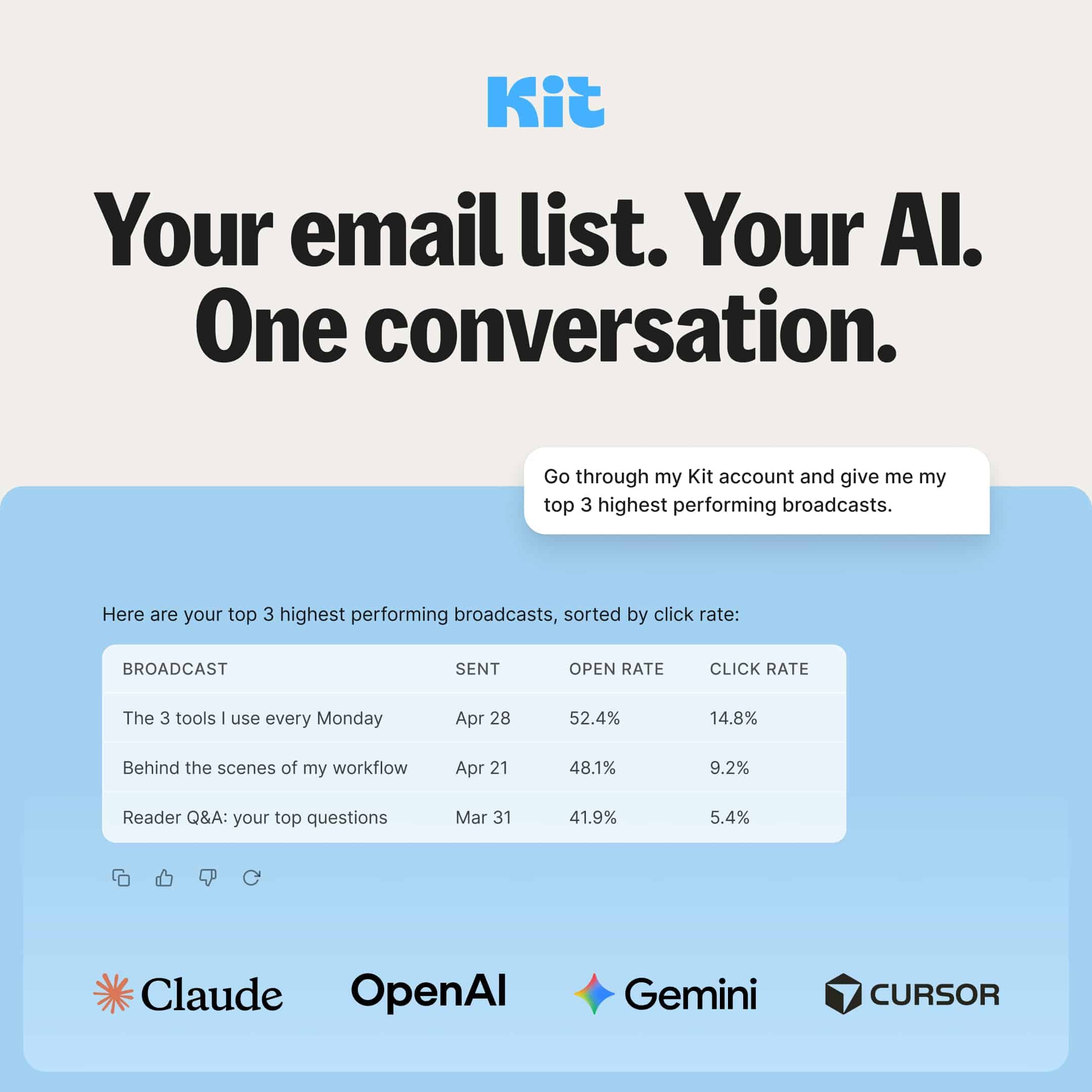
For example, you could ask:
- Which subject lines perform best?
- Which emails generated the most engagement?
- What should I improve next?
Instead of guessing, your AI can base its answers on your real email performance.
It can also help you take action by drafting emails, building sequences, tagging subscribers, and organizing workflows directly in Kit.
To me, that’s what makes Kit MCP interesting.
It turns AI from a writing assistant into something that understands your business.
It’s one of the features I’m most excited to try when I upgrade later this year.
Why I’ve Stayed With Kit
I’ve looked at other email platforms over the years, but I’ve never seriously felt the need to switch.
That’s partly because Kit has continued to evolve.
Features like Subscriber Signals and Kit MCP weren’t available when I first signed up, yet they’re solving problems I’m starting to have today.
That’s one of the things I appreciate most.
It feels like a platform I can grow with instead of eventually growing out of.
A Small Feature I Really Appreciate
One underrated feature I really appreciate is that Kit lets creators use Kit’s business address instead of their personal home address.
That matters more than many beginners realize.
Under the CAN-SPAM Act, marketing emails need to include a physical mailing address.
If you work from home, you may not want your personal address attached to every newsletter you send. (I sure don’t).
Kit helps solve that problem, which is one of those small details that makes the platform feel very creator-friendly.
Final Thoughts: Is Kit Worth It?
I don’t think Kit is the perfect platform for everyone.
But I do think it’s one of the easiest email marketing tools to actually stick with, and that matters more than most people realize.
My own experience certainly wasn’t perfect. I started, stopped, got discouraged, and had to learn along the way.
But I’m glad I stayed with it.
Looking back, I don’t think success came from choosing the perfect email platform.
It came from showing up consistently, learning from my mistakes, and gradually building a newsletter people genuinely wanted to read.
Kit simply gave me the tools to do that.
If you’re just getting started, I’d begin with the free plan.
Learn the basics.
Build the habit.
Upgrade when your business gives you a reason to—not because someone tells you that you should.
Frequently Asked Questions
*We only recommend tools and resources we personally use and love. These are essentials we genuinely believe can support you, just as they’ve supported us.
Statista Research Department."E-mail marketing worldwide - statistics & facts." Statista, 10 December 2024, https://www.statista.com/topics/1446/e-mail-marketing/#topicOverview. Accessed 28 December 2024.

Malin, the co-founder of Courier Wellness, is well-informed in nutrition and health and brings her own unique perspective to the world of holistic wellness. With a passion for writing and a deep interest in wellbeing, she wants to create content that fosters balance and nourishment for the mind and body.